
Summary
Color is more than visual appeal — it’s a language of nutrients.
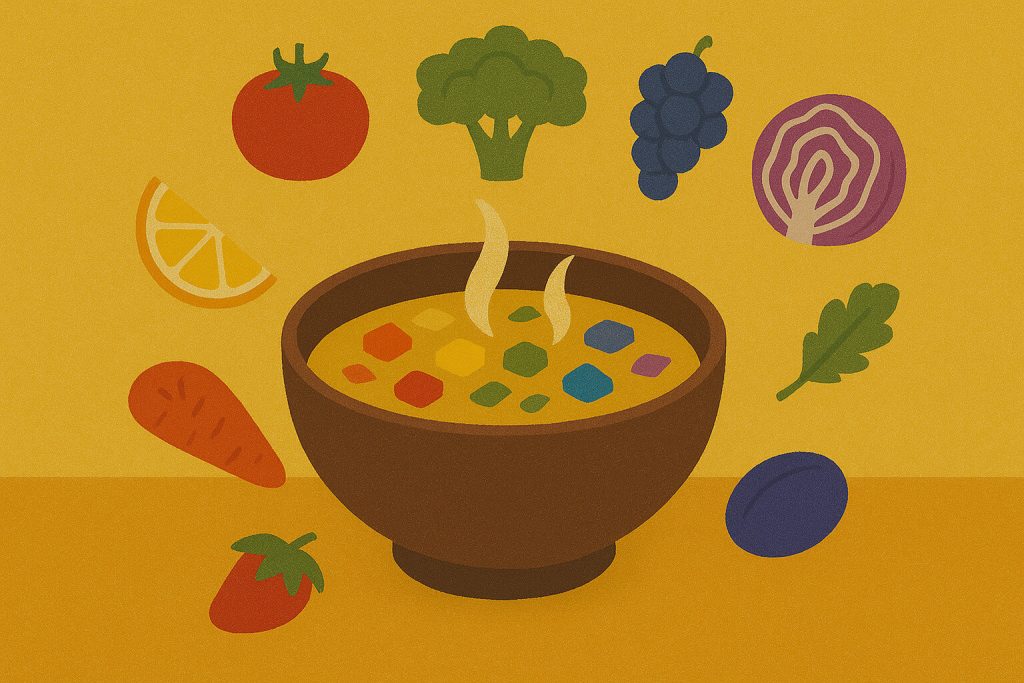
Each natural color in food reflects a unique set of phytochemicals that influence human health. SOUPGOD’s “Seven-Color Soup” concept translates this science into harmony: every hue contributes to balance, protection, and vitality.
Main Text
Traditional Chinese culture connects color with the Five Elements and organ systems:
- Green (Wood) nourishes the liver.
- Red (Fire) strengthens the heart.
- Yellow (Earth) supports the spleen.
- White (Metal) cleanses the lungs.
- Black (Water) fortifies the kidneys.
SOUPGOD expands this palette into seven colors — adding Blue and Purple to complete the modern nutritional spectrum.
Modern nutritional science provides biochemical confirmation for this system.
- Green vegetables like spinach and bok choy are rich in chlorophyll and magnesium, promoting detoxification and cell regeneration.
- Red ingredients such as tomatoes and goji berries contain lycopene and beta-carotene, which enhance cardiovascular function.
- Yellow foods (pumpkin, corn, yam) are dense with lutein and flavonoids that boost immunity and gut health.
- White elements (pear, lotus seed, lily bulb) contain allicin and polysaccharides for respiratory balance.
- Black and purple ingredients (black beans, seaweed, purple rice) provide anthocyanins and iron to restore kidney vitality and blood quality.
- Blue pigments from butterfly pea flower or blue spirulina offer antioxidant protection for the brain and nerves.
The synergy of color and function is not symbolic but scientific.
In chromo-nutrition, every pigment corresponds to a molecular signature that interacts with specific enzymes, receptors, and pathways.
Thus, a colorful soup isn’t just beautiful — it’s biochemically complete.
Conclusion
A rainbow in your bowl mirrors harmony in your body.
Eat the spectrum, and you nourish every organ — just as nature intended.
References (APA 7th)
- Liu, R. H. (2013). “Health-promoting components of fruits and vegetables.” Advances in Nutrition, 4(3), 384S–392S.
- Wu, X., & Prior, R. L. (2005). “Systematic identification of phytochemical pigments and their antioxidant roles.” Journal of Agricultural and Food Chemistry, 53(8), 2589–2599.
- Zhang, Y., & Zhou, W. (2021). “Integrating chromatic therapy and functional food science in modern dietary design.” Food Chemistry Reviews, 19(2), 134–149.
 English
  香港中文
香港中文  简体中文
简体中文