
Summary
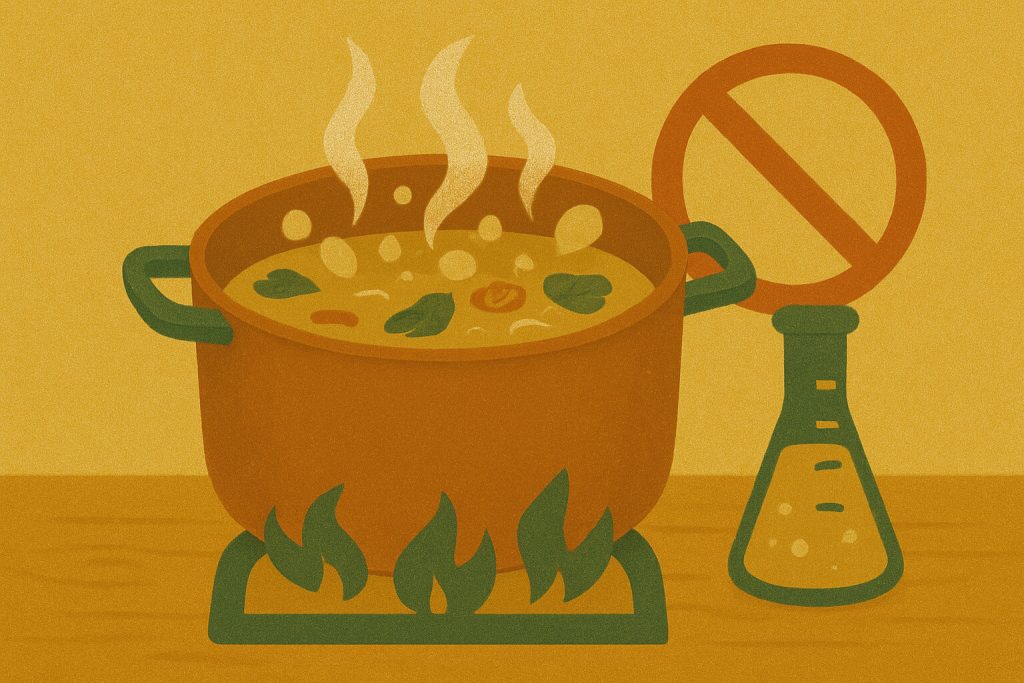
The secret to a perfect soup lies not in speed but in patience. Boiling soup too violently destroys its structure, flavor, and nutritional integrity. Gentle simmering—where the surface softly trembles—is the key to unlocking the deep essence of ingredients without breaking their molecular harmony.
Main Text
In the art of soup making, “fire control” is both science and philosophy. When a soup is boiled rapidly, the high heat causes proteins such as collagen and albumin to coagulate too quickly, forming cloudy particles and excessive foam. This not only affects the appearance but also damages delicate amino acids and peptides that contribute to umami flavor and nutritional value.
Studies from food chemistry journals have shown that maintaining water temperatures between 85°C and 95°C (185–203°F) allows collagen fibers to gradually dissolve into gelatin, creating that silky texture prized in slow-cooked broths. In contrast, rapid boiling above 100°C accelerates evaporation, concentrates sodium, and leads to nutrient degradation, especially vitamin C and B-complex compounds.
Traditional Chinese cooking refers to this process as “小火慢熬” (gentle simmering). It embodies balance—the harmony of fire and water. In contrast, Western culinary science calls it “low and slow,” a method now validated by thermodynamics and diffusion kinetics. The slower the extraction, the more complete the release of flavor molecules, minerals, and umami components such as glutamic acid.
For herbal or medicinal soups, temperature control becomes even more critical. Many phytochemicals—such as flavonoids, saponins, and polysaccharides—are heat-sensitive. Overheating can alter their structure, diminishing their bioactivity and changing the soup’s therapeutic function.
Modern culinary equipment, such as induction stoves and slow cookers, now allows precise temperature management, merging ancient wisdom with modern convenience. Whether simmering a bone broth, herbal tonic, or vegetable soup, patience remains the key ingredient.
Conclusion
Boiling is easy. Simmering is mastery.
In the gentle dance of heat and time, soup transforms from mere ingredients into nourishment for both body and soul.
References (APA 7th)
- McGee, H. (2020). On Food and Cooking: The Science and Lore of the Kitchen. Scribner.
- Tang, Y., & Lin, H. (2018). “Thermal degradation of amino acids and peptides during prolonged boiling.” Journal of Food Chemistry, 274, 256–264.
- Chen, L., & Xu, Q. (2019). “Slow simmering as a culinary preservation of nutrients in Chinese soups.” Asian Food Science Journal, 12(3), 45–53.
 English
  香港中文
香港中文  简体中文
简体中文