
摘要
In a world obsessed with speed, soup teaches patience.
The act of simmering — allowing ingredients to merge over time — is both a culinary and spiritual exercise. It embodies the Taoist principle of wu wei (effortless action) and mindfulness through nourishment.
正文
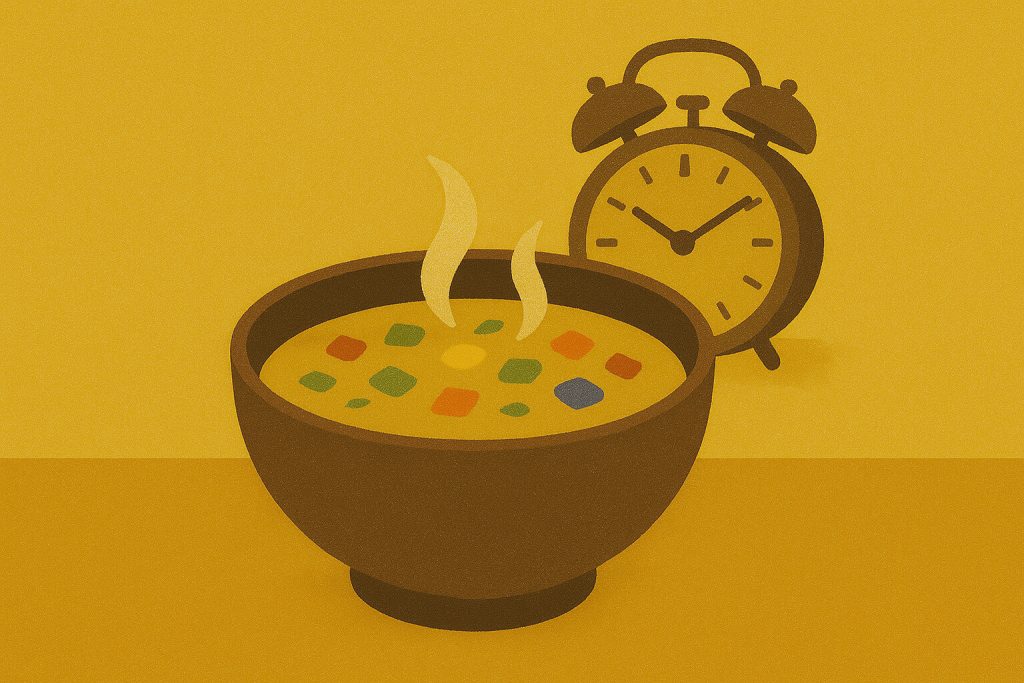
To cook soup is to slow down time.
As bones release gelatin, herbs surrender fragrance, and water thickens into essence, something invisible also brews — tranquility.
In both Chinese and Western tradition, slow cooking is a symbol of transformation.
In ancient China, healers prescribed decoctions that simmered “as long as a stick of incense burns,” an early measurement of patience. In Europe, French consommés and Italian brodos followed similar philosophies — extraction through gentleness.
Modern physiology confirms that slow cooking reduces the formation of harmful compounds such as AGEs (advanced glycation end-products) while enhancing amino acid digestibility. It also helps develop kokumi — a sensory dimension linked to calcium and glutathione, often described as “mouthfulness.”
More profoundly, slow soup preparation promotes emotional balance.
Studies on culinary therapy suggest that mindful cooking lowers cortisol levels and induces parasympathetic calm. The rhythmic act of stirring, smelling, and tasting reconnects us to primal comfort and social ritual.
SOUPGOD embraces this philosophy: every broth carries the value of slowness — time as an ingredient. It’s not only about taste but about returning to presence.
結論
To simmer a soup is to meditate in motion.
Each bubble is a heartbeat — gentle, constant, alive.
參考資料
- Brown, L. (2019). “Culinary mindfulness: How slow cooking reduces stress and enhances well-being.” Journal of Holistic Nutrition, 8(4), 220–237.
- Chen, Z. (2018). “The chemistry of long boiling: Nutrient dynamics in slow-simmered broths.” Chinese Journal of Food Science, 14(3), 115–122.
- Duh, M. S., & Kao, J. (2021). “Therapeutic gastronomy: Mindfulness and cooking in health psychology.” Mind-Body Medicine Review, 6(1), 51–62.
 English
  香港中文
香港中文  简体中文
简体中文